
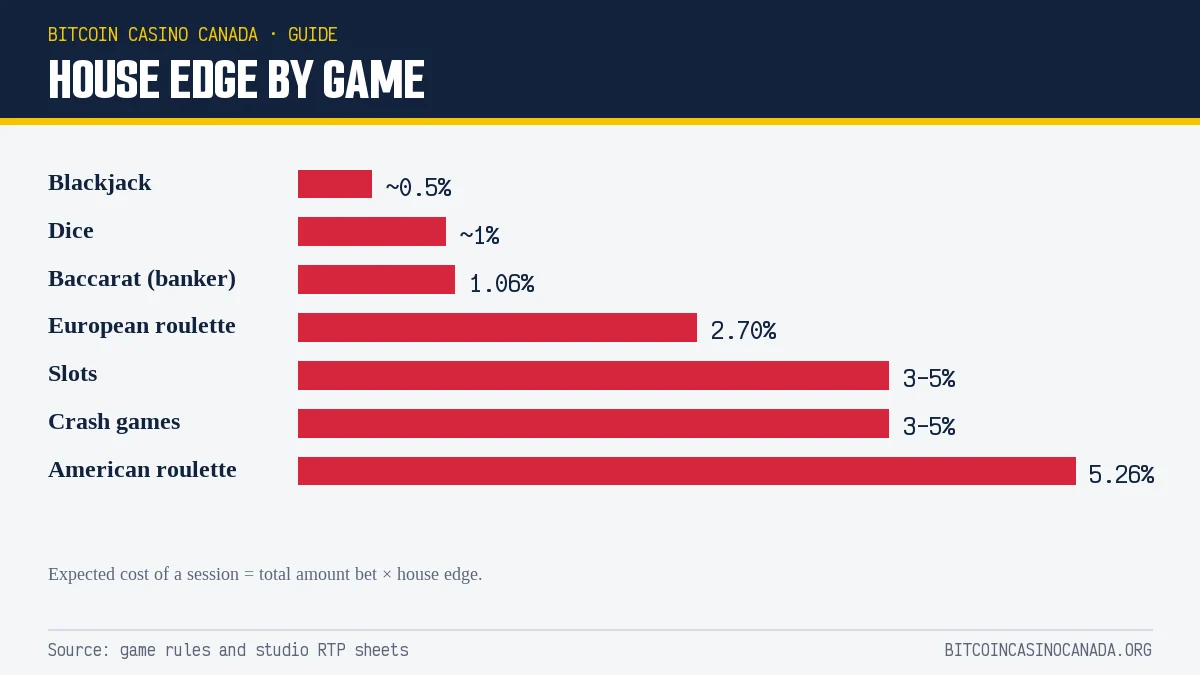
The edge of common games
| Game | Typical house edge |
|---|---|
| Blackjack, basic strategy | ~0.5% |
| In-house dice | often ~1% |
| Baccarat, banker bet | ~1.06% |
| European roulette | 2.70% |
| Slots | 3–5% (RTP 95–97%) |
| Crash games | 3–5% |
| American roulette | 5.26% |
The cost of a session
Expected cost = total amount bet × house edge.
If you play 500 spins at $1 on a 96% slot, you bet $500 and expect to lose about $20. Fast games multiply the total bet quickly: 1,000 dice rolls at $1 is $1,000 bet, about $10 at a 1% edge.
Why systems fail
Martingale doubles after each loss to win back one unit. It works until a losing streak meets the table limit or your budget, and then it loses everything at once. Every bet in the sequence carries the same edge, so the sequence does too. The same logic defeats every staking plan.
Our partner crypto casino takes Bitcoin deposits and pays out in coin.
RTP and house edge are one number
A slot that returns 96% has a 4% house edge. A dice game with a 1% edge returns 99%. Studios publish the RTP; table games are usually described by the edge. Converting is simple: subtract one from 100%.
The cost per hour
The edge per bet is only half the story. The other half is how many bets you make in an hour.
| Game | Edge | Bets per hour | Stake | Expected cost per hour |
|---|---|---|---|---|
| Slot | 4% | 500 | C$1 | C$20 |
| Crypto dice, auto-bet | 1% | 1,000 | C$1 | C$10 |
| Live blackjack, basic strategy | 0.5% | 60 | C$10 | C$3 |
| European roulette, RNG | 2.7% | 100 | C$5 | C$13.50 |
A low edge on a fast game can cost more than a higher edge on a slow one. Count both before choosing where your budget goes.
What you can control
You cannot change the edge, but you can choose games with a lower one, play fewer rounds per hour, avoid side bets, use cashback where it is offered, and set a budget. The crypto casino games page lists the edge of each game, and wagering requirements shows how the edge decides a bonus's value.
House edge at crypto casinos
Crypto casinos add two kinds of games to the usual slots and tables: in-house originals and crash games. Originals such as dice often run at an edge of about 1%, among the lowest in any lobby. Crash games from studios publish returns from 95% to about 99%. The lower edge is real, but those games are also the fastest, so the cost per hour can match a slot's.
Questions and answers
What is the house edge?
The average share of each bet the casino keeps over a very long run. A 3% edge means about 3 cents per dollar wagered.
How is RTP related to the house edge?
They add up to 100%. A 96% RTP slot has a 4% house edge.
What is variance?
How far results swing around the average in the short run. High-variance games swing widely; low-variance games stay close to the average.
Which games have the lowest edge?
Blackjack with basic strategy, around 0.5%; many in-house dice games, around 1%; baccarat banker, about 1.06%.
Which games have the highest edge?
Some game shows, keno and side bets often carry edges well above 5%.
Can a betting system beat the house edge?
No. Every bet carries the same edge, so any combination of bets carries it too.
Why do people win then?
Variance. In the short run, results can be far from the average in either direction.
How do I estimate the cost of a session?
Multiply the total amount you will bet by the house edge. $1,000 in bets on a 96% slot costs about $40 on average.
Does provably fair change the house edge?
No. It proves results were not altered; the edge is still built into the payouts.
Does cashback change the edge?
It lowers your effective cost, because part of what you lose comes back.